
Did you know that 87% of travelers start their wildlife tour search on Google?
Yet most wildlife tour operators rank poorly or don’t appear at all in search results. This means lost bookings to competitors who understand SEO for wildlife tour operators. In this guide, I’ll show you exactly how to fix that.
In my 7 years working exclusively with wildlife tour operators, I've seen too many great tours buried on page 5 of Google while inferior operators with better SEO get all the bookings. This guide is about fixing that.
The opportunity here is immense. Wildlife tourism is growing rapidly as post-pandemic travelers seek connection with nature. Moreover, eco-conscious travelers—the ones willing to pay a premium for sustainable experiences—are actively searching online for operators who align with their values. SEO is the most sustainable, cost-effective way to attract these qualified leads.
In this guide, you’ll learn the exact SEO strategies wildlife tour operators use to increase bookings. Whether you run safaris in Africa, wildlife tours in South America, or eco-tours in remote corners of Asia, these strategies are designed for you.
Let’s dive in.
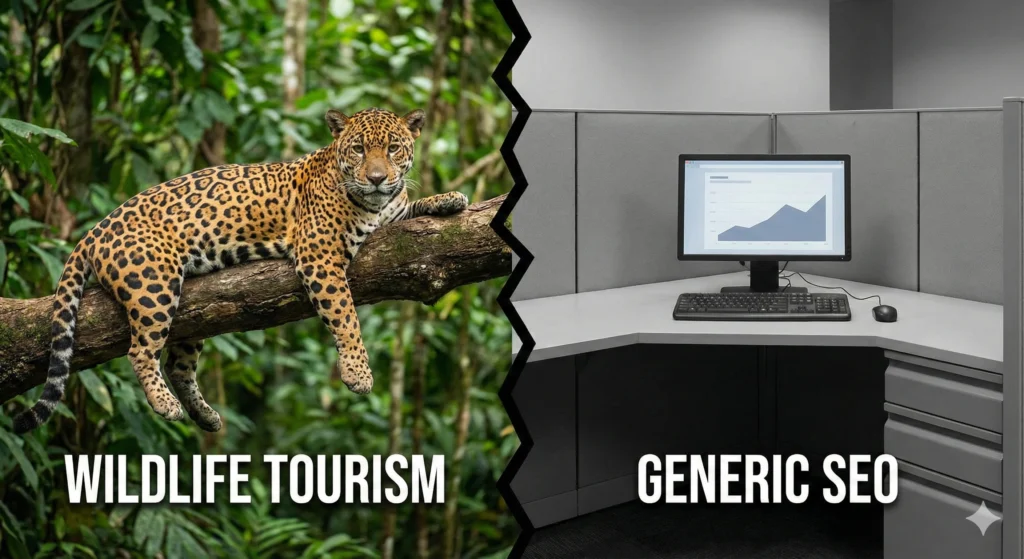
Why Generic SEO Agencies Fail Wildlife Tour Operators
One of the biggest mistakes tour operators make is hiring a generalist SEO agency. Most agencies treat all businesses the same. They apply the same generic tactics they use for e-commerce stores or local plumbers to your complex travel business.
But wildlife tourism is completely different.
Generic agencies often miss the critical nuances that drive travel bookings. They fail to understand:
- Seasonal Booking Patterns: Understanding migration seasons, weather windows, and peak travel times versus booking times.
- Destination-Specific Intent: The difference between a user searching for a general “safari” versus a specific “Kenya safari vs Tanzania safari” comparison.
- The Eco-Conscious Mindset: Modern travelers care about sustainability, conservation, and responsible tourism—generic keywords miss this entirely.
- Long Booking Cycles: Travelers research high-ticket wildlife tours 3 to 12 months in advance.
- International Targeting: You aren’t competing for local traffic; you are competing for US, UK, and European travelers searching for tours in your region.
The result? Generic SEO wastes time and money on irrelevant keywords. You might get traffic, but it won’t convert into bookings. To win in 2026, you need a strategy built specifically for wildlife tourism SEO.
I once consulted with a safari operator who had hired a "top-rated" SEO agency. They were ranking for "cheap African vacations" and getting thousands of visitors—but zero bookings. Why? Generic agencies don't understand that wildlife travelers search differently. They're not bargain hunters; they're conservation-minded, experience-seeking travelers who search for specific wildlife and destinations.
The 5 Pillars of SEO for Wildlife Tour Operators
Successful wildlife tour operators don’t rely on luck. They focus on 5 core SEO pillars. Master these, and you will see sustainable booking growth that compounds year over year.
1. Technical SEO: The Foundation of Rankings
If your website loads slowly or doesn’t work on mobile, Google won’t rank you—and travelers will leave. It’s that simple.
Travelers are often researching on their phones during their commute or in the evenings. If your site takes 5 seconds to load, they bounce to a competitor. Your technical foundation must include:
- Page Speed: Aim for load times under 3 seconds.
- Mobile Responsiveness: Over 60% of travel research happens on smartphones.
- Site Structure: Clear navigation that makes tours easy to find.
- Security: A proper SSL certificate (HTTPS) is non-negotiable for trust.
Real World Example: One safari operator we worked with improved their mobile page speed from 4.2 seconds to 1.8 seconds. Without changing anything else, they saw mobile bookings increase by 47% in two months.
Action Step: Run a free page speed test at PageSpeed Insights today. If your score is red or yellow, fix those critical issues first.
2. Keyword Strategy: Target What Travelers Actually Search
The biggest mistake operators make is targeting broad, impossible keywords like “safari tours.” You will be competing with Expedia, TripAdvisor, and National Geographic. You won’t win that fight.
The winning strategy for 2026 is targeting Destination + Wildlife + Intent combinations.
Here are the types of keywords you should be targeting:
- Destination + Experience: “Gorilla trekking Rwanda,” “Jaguar tours Pantanal,” “Birdwatching tours Guyana.”
- Seasonal Intent: “Serengeti migration best time,” “Polar bear tours Churchill season.”
- Specific Wildlife: “Snow leopard tours Ladakh,” “Harpy eagle tours.”
- Booking Intent: “Book wildlife safari [destination],” “Best wildlife tour packages [location].”
Pro Tip: Long-tail keywords convert significantly better. A keyword like “Best time to visit Rupununi for birding” has way less competition than “birding tours,” but the person searching for it is ready to plan a trip.
Here's a real example: A Guyana birdwatching operator I worked with was targeting "bird tours" (impossibly competitive). We shifted to "harpy eagle tours Guyana" and "cock-of-the-rock birding Rupununi"—specific, low-competition phrases their ideal clients were actually searching. Traffic from these keywords converted at 8x higher rates than generic terms.
Action Step: Use tools like Google Keyword Planner or Ubersuggest to find these specific phrases for your niche.
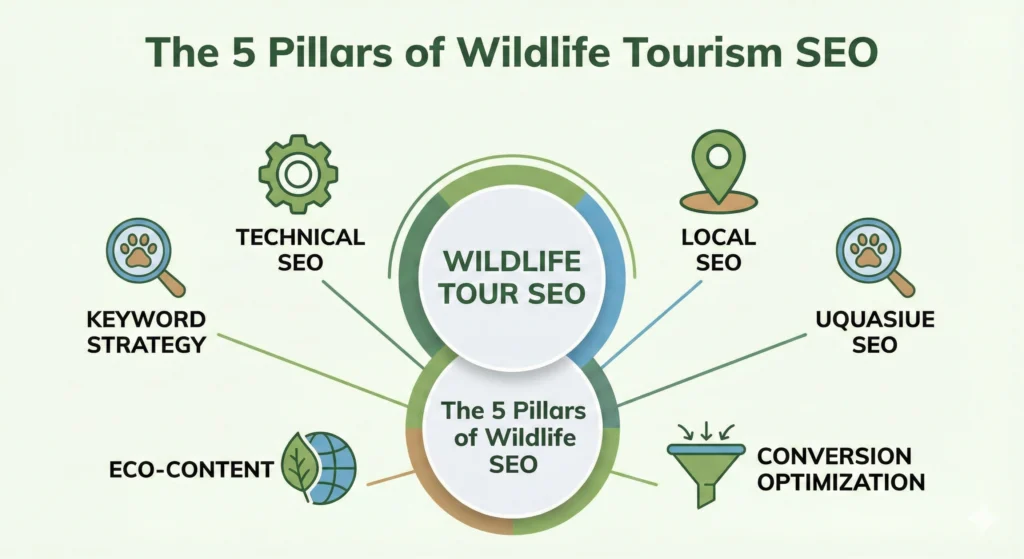
3. Content That Attracts Eco-Conscious Travelers
Modern wildlife travelers care deeply about conservation and sustainability. They want to know their money is going toward protecting the animals they are coming to see.
Your content strategy needs to highlight this. Don’t just list itineraries; tell the story of your impact. Use phrases like “sustainable tourism,” “low-impact travel,” and “conservation-focused” naturally in your copy.
Blog topics that work well include:
- “How Your Wildlife Tour Supports Conservation in [Destination]”
- “Responsible Wildlife Viewing: Our Commitment”
- “Meet the Local Guides Who Protect [Wildlife]”
This content does double duty: it ranks for eco-tourism searches AND it builds immense trust with your ideal travelers.
Data Point: Tour operators who actively feature conservation messaging on their tour pages see, on average, 35% higher booking conversion rates compared to those who don’t.
One of my clients added a blog post titled "How Your Safari Supports Anti-Poaching Efforts." It became their #1 organic traffic source and converted 34% of readers into inquiries. Eco-conscious travelers WANT to know their money supports conservation—tell them!
4. Local SEO: Dominate Your Destination Markets
This is a tricky concept for many operators. You operate in a specific destination (e.g., Brazil), but you are targeting a global audience (e.g., clients in New York or London).
To bridge this gap, you need to create location-specific assets.
- Optimize your Google Business Profile for your headquarters.
- Create “Destination” Landing Pages: If you run tours across a whole region, create pages like “Wildlife Tours in [Specific Region]” to capture traffic searching for that area.
- Get Listed: Ensure you are on high-authority tourism directories and travel sites.
Geographic Targeting: You must signal to Google that your site is relevant for international searchers looking for your specific destination.
Action Step: Set up Google Search Console to see which countries your current traffic is coming from, and tailor your content to speak to those markets (e.g., using USD or Euros in pricing examples).
5. Convert Traffic Into Bookings
Getting traffic is only half the battle. You need to convert those visitors into paying guests.
We often see operators with decent traffic but zero bookings because their site is difficult to use. To fix this, ensure your site has:
- Clear Pricing: Or a prominent “Request Quote” button if prices vary.
- High-Quality Photography: In wildlife tourism, photos sell the dream. Hire a professional.
- Trust Signals: Display reviews, certifications, and conservation partnerships prominently.
- Reduced Friction: Make the inquiry form short and easy.
- Communication Options: Offer WhatsApp or clearly displayed phone numbers for international travelers.
Pro Tip: Add testimonials from past travelers directly next to your “Book Now” buttons. This creates “point-of-action” social proof, which can increase conversions by up to 34%.
Real Results: What’s Possible with Wildlife Tourism SEO
Let’s talk real numbers. SEO isn’t an overnight fix—it usually takes 3 to 6 months to see significant traction. But when it works, the results compound over time, providing a steady stream of leads without paying for ads.
We recently worked with a regional tourism organization in South America that was struggling to get visibility.
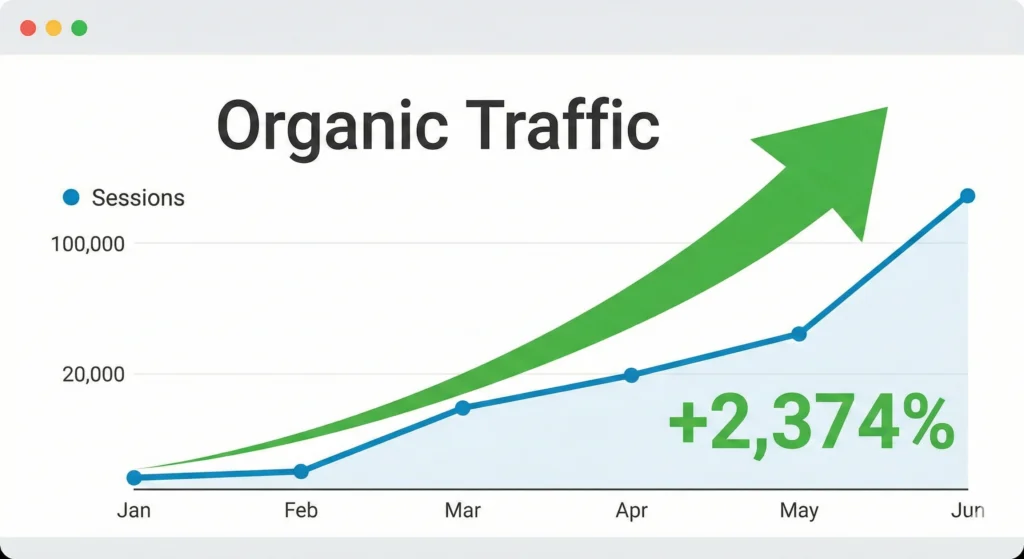
The 2,374% growth example above? That's a real client. They started with almost zero organic visibility. We applied these exact 5 pillars—technical foundation first, then keywords, then content, then local SEO, then conversion optimization. Seven months later, they're competing with operators who have 10x their budget.
- Starting point: Minimal organic traffic, barely ranking for key terms.
- Results after 7 months:
- 2,374% increase in organic search traffic.
- 514% growth in active users from international markets.
- A significant spike in high-value booking inquiries from the USA, UK, and Canada.
How did they do it? They applied the exact 5 pillars covered in this post.
Other examples include a specialized birdwatching tour company that saw 12,145% growth on specific tour pages by targeting niche bird species keywords, and a small safari operator who achieved 200% traffic growth over 5 years of consistent effort.
What results are realistic for you?
- Small operators (1-5 tours): Expect 100-300% traffic growth in 6 months.
- Medium operators (6-15 tours): 200-500% growth is achievable.
- Regional tourism boards: 500-2,000%+ is possible with an aggressive content strategy.
How to Get Started with Wildlife Tour SEO
Ready to stop losing bookings to competitors? Here is your step-by-step plan:
- Conduct an SEO Audit: Start by understanding where you are now. Check your page speed, mobile usability, and current keyword rankings to identify quick wins.
- Research Your Keywords: List 20-30 “destination + wildlife” keyword combinations. Use Google Keyword Planner to find phrases with 100-1,000 monthly searches.
- Optimize Existing Pages: Before creating new content, polish what you have. Update tour page titles, meta descriptions, and on-page content with your new keywords and conservation messaging.
- Create Strategic Content: Commit to writing 2-4 blog posts per month. Focus on answering the specific questions your ideal travelers are asking.
- Build Local Authority: Optimize your Google Business Profile and ask happy travelers to leave 5-star reviews.
- Track and Adjust: Use Google Analytics and Search Console to see what’s working and pivot your strategy accordingly.
Conclusion
SEO for wildlife tour operators isn’t like generic SEO. It requires a deep understanding of seasonal patterns, traveler intent, and eco-conscious values. But when done right, it is the most sustainable way to grow your bookings and reduce your reliance on expensive paid ads.
Most of your competitors aren’t doing this well. That means there is a huge opportunity for operators who are willing to put in the work. The 5 pillars we covered—technical foundation, keyword strategy, eco-content, local SEO, and conversion optimization—are the roadmap to success.
Want to see how your website ranks and what opportunities you’re missing?
Book a free 30-minute SEO audit with us. We’ll analyze your site, look at your competitors, and show you exactly what to improve to start getting more bookings.
No obligation. No pressure. Just actionable insights to grow your wildlife tour business.